


Are you investing in the future, or are you accidentally becoming a curator of a digital museum?
In 2004, a man walked into a Blockbuster to return a movie and was hit with a late fee that cost more than the DVD itself. That minor friction, that tiny moment of customer pain, birthed Netflix. Before Blockbuster realized they weren’t in the “video rental” business, but the “convenience” business, the world had already moved on. Their 9,000 stores weren’t an asset; they were a digital anchor that dragged them to the bottom.
Today, we are at a similar precipice. In early February 2026, the software market experienced a “Decapitation.” Over $1 trillion in market value evaporated in a single week. This wasn’t a random crash; it was a structural rejection of the old guard.
Why? Because the “unit of value” in the economy has shifted. For twenty years, we bought “seats” for humans. In the next ten years, we will buy “outcomes” from machines. AI is reshaping SaaS by replacing single-feature tools, rigid rule-based automation, and manual reporting dashboards. If you are holding companies that rely on growing human headcount to grow their own revenue, you are betting against the most powerful force in history.
The Endangered Species: Why “Useful” is No Longer “Safe”
As AI becomes more effective, we found over 15 stocks that could gradually go to zero if management fails to innovate or pivot to an irreplaceable Agentic Autonomy. The danger isn’t that these tools stop working; it’s that they become invisible. They are being “swallowed” by the foundational layer of the internet. Here are our most vulnerable 3
1. DocuSign (DOCU): The Pen in a World of Execution
Think of the last time you “signed” a document. It felt like a chore. DocuSign thrived by making that chore digital. But as we sit in 2026, we are moving into Agentic Contracting.
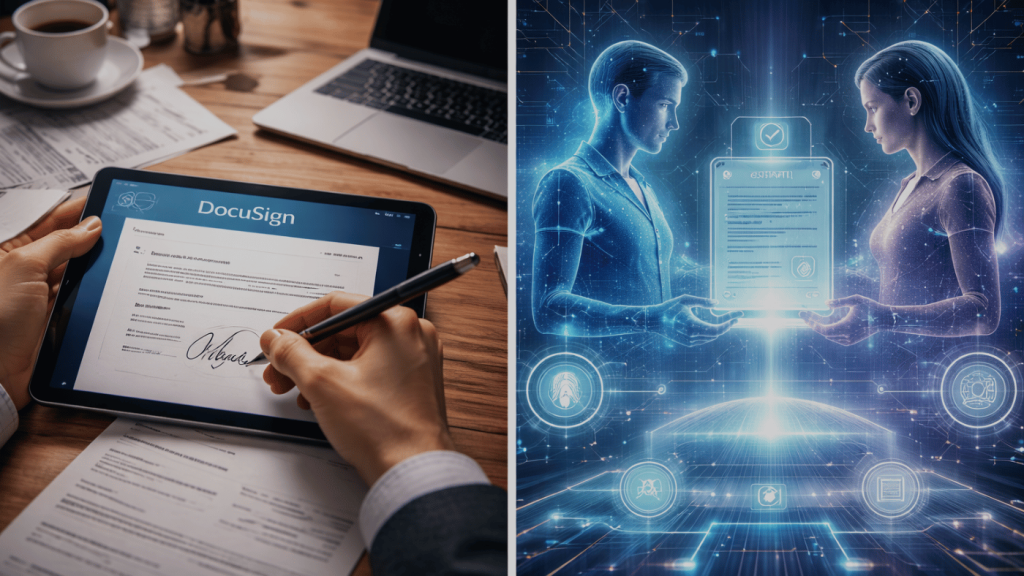
What happens when an AI agent negotiates a contract, verifies identity via biometric hash, and executes the deal via self-triggering code? The “signature” becomes a trivial, invisible background event. In this new world, you don’t “go to DocuSign” to sign; the agreement happens autonomously between two machines.
DocuSign is pivoting to Intelligent Agreement Management (IAM), with 25,000 customers already on board. They are trying to move “upstream” to own the data inside the contract. But they are fighting a brutal battle: they are trying to charge for a “pen” in a world that is learning to write with its mind. If they can’t own the logic of the deal, the part where the AI actually decides what the terms are, their pricing power will evaporate. When the “seat” (the human contract) disappears, so does the subscription fee.
2. Dropbox (DBX): The Digital Attic vs. Total Recall
We used to spend hours “organizing” files. Dropbox was our savior. But look at the 2026 landscape: Windows Recall and Apple Intelligence have turned the operating system into a Semantic Retrieval Engine.

Do you really want to pay for a third-party box to “sync” your files when your computer already has a perfect photographic memory of every byte you’ve ever touched?
Storage is now a commodity; retrieval is the value. If the retrieval layer is free and integrated at the OS level, the standalone filing cabinet is a legacy tax that CFOs are already cutting. Dropbox Dash, their AI-powered universal search tool, is a valiant effort to become the “connective tissue” of your work. But can a software layer truly outrun the giants who control the hardware and the operating system kernel, the core program that manages everything on your device? If your operating system already knows where everything lives, you don’t need a folder. You just need a prompt.
3. Zoom (ZM): The “Presence” Trap
The darling of the pandemic is now a “System of Presence” in a world craving Autonomy: Imagine a CEO in 2026. She doesn’t spend 8 hours a day on Zoom calls anymore. Why? Because her AI avatar represents her in “Level 1” meetings, negotiates the basic terms, and provides a 30-second video summary for her to review.

Zoom’s revenue growth has slowed to a crawl (~4%). Their $7.9 billion cash pile is a massive safety net, but cash doesn’t buy a moat in a shifting tide. They lack the proprietary “System of Record” data that keeps users locked in. In the AI decade, “being there” is no longer the product; doing the work is. Zoom is a feature, and features eventually get bundled for free into the platforms that own the actual work (like Microsoft 365 or Google Workspace).
The Winners: 4 Rocket Ships Fueled by AI
While the “seat-based” giants crumble, a new elite class is emerging. These are companies that own the Logic, the Speed, and the Security that AI requires to function. These are the four SaaS stocks Whiz Investors are gradually adding to their portfolio:
1. ServiceNow (NOW): The AI Control Tower
ServiceNow has stopped selling “software” and started selling “Results.” They aren’t just helping an HR person track a ticket; their Now Assist agents resolve the ticket autonomously.
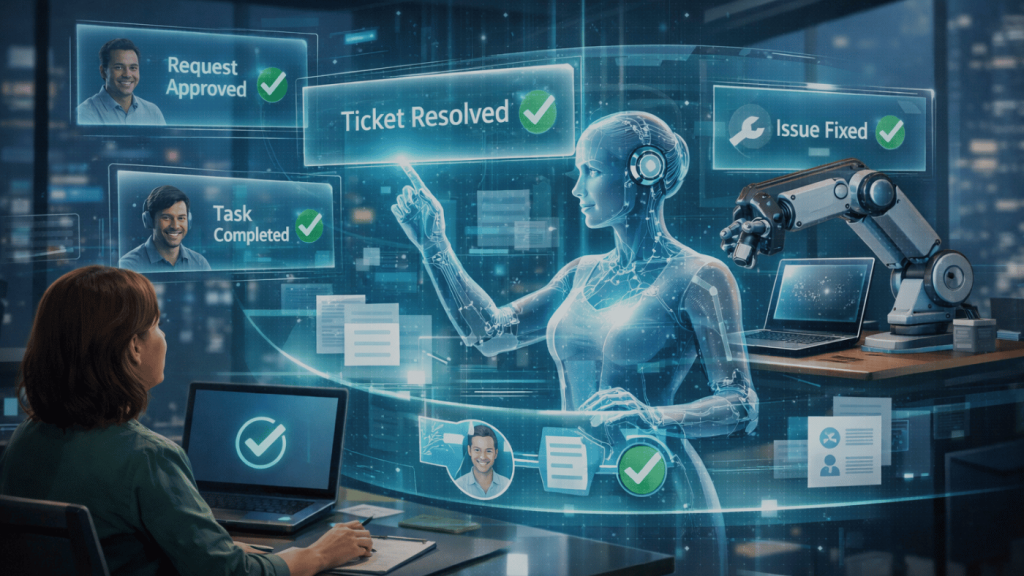
By charging per resolved issue instead of per human seat, they capture the massive labor savings they provide. If an AI agent replaces the work of five human IT staffers, ServiceNow can charge for the value of those five staffers, not just a single license fee. With 2026 revenue projections hitting $15.5 billion and a dominant 36% FCF margin, they have become the “Operating System” for the autonomous enterprise. They aren’t a tool; they are the brain that directs the agents.
2. Cloudflare (NET): The Electric Grid for AI
AI magic requires zero latency. If an AI agent stutters for three seconds while “thinking,” the business process breaks. Cloudflare owns the global network that makes AI instant.

Their Workers AI allows models to run at the Edge—right in the user’s local city, rather than a data center thousands of miles away. In 2026, they are seeing 34% revenue growth and a 120% net retention rate. They are the toll booth for the agentic internet. As AI-to-AI traffic doubles every quarter, Cloudflare sits in the middle of every transaction, collecting a “network tax” on the entire AI economy.
3. CrowdStrike (CRWD) / 4. SentinelOne (S): The AI Immune System
In the next decade, you won’t be fighting a hacker in a hoodie; you’ll be fighting an autonomous attack agent that rewrites its own code every millisecond to find a hole in your defense.

The Fact: You cannot defend against that with manual analysts or old-school “rules.” You need a Global Telemetry Moat. CrowdStrike and SentinelOne see trillions of events in real-time across millions of endpoints. Their AI models (Falcon and Purple AI) learn from an attack in London and immunize a company in Lagos within five seconds. They are the only platforms fast enough to keep a company alive in a state of constant, machine-speed digital warfare. While the “SaaSpocalypse” hit the sector, either of these two represents the “must-have” insurance policy for the modern world.
The 2026 “SaaSpocalypse” is a Re-Foundation
This isn’t a market crash…
it’s a purge.
Legacy SaaS was built on the assumption that software helps humans be more productive. Future “Rocketships” are built on the reality that software is the worker. If your portfolio is weighted toward tools that merely “help humans work,” you are betting on a past that is rapidly receding. The real “alpha” lies in the infrastructure that enables machine autonomy. The “seat-based” model is a digital anchor. The “outcome-based” model is the rocket fuel.
The purge is already underway. You can either be a curator of the digital museum, holding onto the “Blockbusters” of the software world, or you can be an architect of the autonomous future. The choice, as always, is driven by the intelligence you navigate with.

At Whiz Investors Navigator (WIN), we don’t just react to the news or follow the trending videos. We reason through the math, analyze the unit of value, and look for those great businesses when the market is too blinded by sentiment to see their true worth. If you want to stop guessing and start navigating the AI decade with data-driven precision, it’s time to elevate your perspective.
The future is being written in tokens and outcomes, not seats and logins. Don’t get left behind.
Does your portfolio pass the “Blockbuster Test”?
Explore the Whiz Intelligence Network (WIN). We use our 21-Question diagnostic framework and 7 rules to find great businesses early, helping you stay ahead of the market crises and sentiments that drag the average investor down.
Start with whiznavigator.com Now